16mm · 4:12 · S/W / B/W · Stumm / Silent · 2026
Every Movie Ever Made In 4:3

Logline
DEEine mögliche Geschichte aller möglichen Filme, reduziert auf zwölf Pixel und eine einzige Rolle 16mm-Film.
Logline
ENEvery film ever made—past and future—reduced to twelve pixels and one possible sequence on a single roll of 16mm film.
Synopsis
DEDiese Arbeit geht von einer einfachen Annahme aus: Jeder digitale Film besteht aus Einzelbildern, und jedes Einzelbild besteht aus Pixeln. Würde man alle möglichen Anordnungen schwarz-weißer Pixel in einem ausreichend großen Raster erzeugen (z.B. 1920 × 1080), entstünde irgendwann jedes mögliche Bild und damit jeder Film, der jemals gemacht wurde und jemals gemacht werden wird. Dafür wären allerdings mehr Einzelbilder notwendig, als es Atome im beobachtbaren Universum gibt.
Anstatt sich dieser unvorstellbaren Totalität in voller Auflösung zu nähern, reduziert die Arbeit das Bild auf ein Raster von 4 × 3 Pixeln. Zwölf binäre Pixel ergeben genau 4.096 mögliche Bilder und ermöglichen es, jeden Film, der jemals gemacht wurde und jemals gemacht werden wird, innerhalb einer einzigen Rolle 16mm-Film zu zeigen – in sehr schlechter Auflösung.
Während die Menge der Bilder vollständig ist, gilt das nicht für ihre Reihenfolge. Die 4.096 Bilder lassen sich in einer unermesslichen Zahl zeitlicher Abfolgen anordnen. Der Film zeigt nur eine dieser möglichen Anordnungen: eine mögliche Geschichte aller möglichen Filme. Andere Geschichten bleiben möglich, aber unrealisiert.
Anstatt die Bilder digital auf Film auszubelichten, werden sie Bild für Bild mit einer 16mm-Bolex-Kamera vom Bildschirm abgefilmt. Dieser manuelle Prozess spiegelt die algorithmische Enumeration der Bilder selbst wider: Jeder rechnerische Schritt wird ein zweites Mal von Hand als körperliche Geste ausgeführt. Durch die Übersetzung von digitalem Code in ein photochemisches Bild verwandelt sich eine abstrakte mathematische Struktur in ein singuläres filmisches Ereignis. Filmkorn, Staub, leichte Schwankungen in Belichtung und Bildstand schreiben Kontingenz in ein System ein, das von mathematischer Vollständigkeit bestimmt ist.
Synopsis
ENThis work begins from a simple proposition: every film is composed of individual images, and every image is composed of pixels. If one could generate all possible arrangements of black-and-white pixels in a sufficiently large grid (say, 1920 × 1080), one would eventually produce every possible image—and therefore every film that has ever been made and every film that ever will be made. Unfortunately, this would require more frames than there are atoms in the observable universe.
Rather than approaching this unimaginable totality at full resolution, the film reduces the image to a 4 × 3 grid of twelve pixels. Twelve binary pixels produce exactly 4,096 possible images, allowing the complete visual universe of the system to be shown within the duration of a single roll of 16mm film.
While the set of images is complete, their order is not. The 4,096 frames can be arranged in an immeasurable number of temporal sequences. The film presents just one of these possible orderings: one possible history of every possible film—in very poor resolution. Other histories remain possible, but unrealized.
Rather than being digitally printed onto film, the images are re-photographed frame by frame from a screen using a 16mm Bolex camera. This manual process mirrors the algorithmic enumeration of the images themselves: every computational step is performed once again by hand as a physical gesture. In translating digital code into a photochemical image, the work transforms an abstract mathematical structure into a singular cinematic event. Grain, dust, slight variations in exposure, and mechanical registration inscribe contingency into a system defined by mathematical completeness.

Technische Daten
Specifications
- JahrYear
- 2026
- LandCountry
- Österreich / Austria
- DauerRuntime
- 4:12 min
- AufnahmeformatShooting format
- 16mm
- FilmmaterialFilm stock
- Kodak Soundstock
- BildformatAspect ratio
- 1,33:1 (4:3)
- FarbeColour
- s/w / b/w
- TonSound
- stumm / silent
- VorführformateExhibition formats
- 16mm / DCP / ProRes
Credits
- Regie, Kamera, SchnittDirector, camera, editing
- Markus Maicher
Zwölf binäre Pixel, 212 = 4.096 Bilder.
Twelve binary pixels, 212 = 4,096 frames.
Screener
Screener-Link für Festivals und Kurator:innen auf Anfrage.
Screener link for festivals and programmers on request.
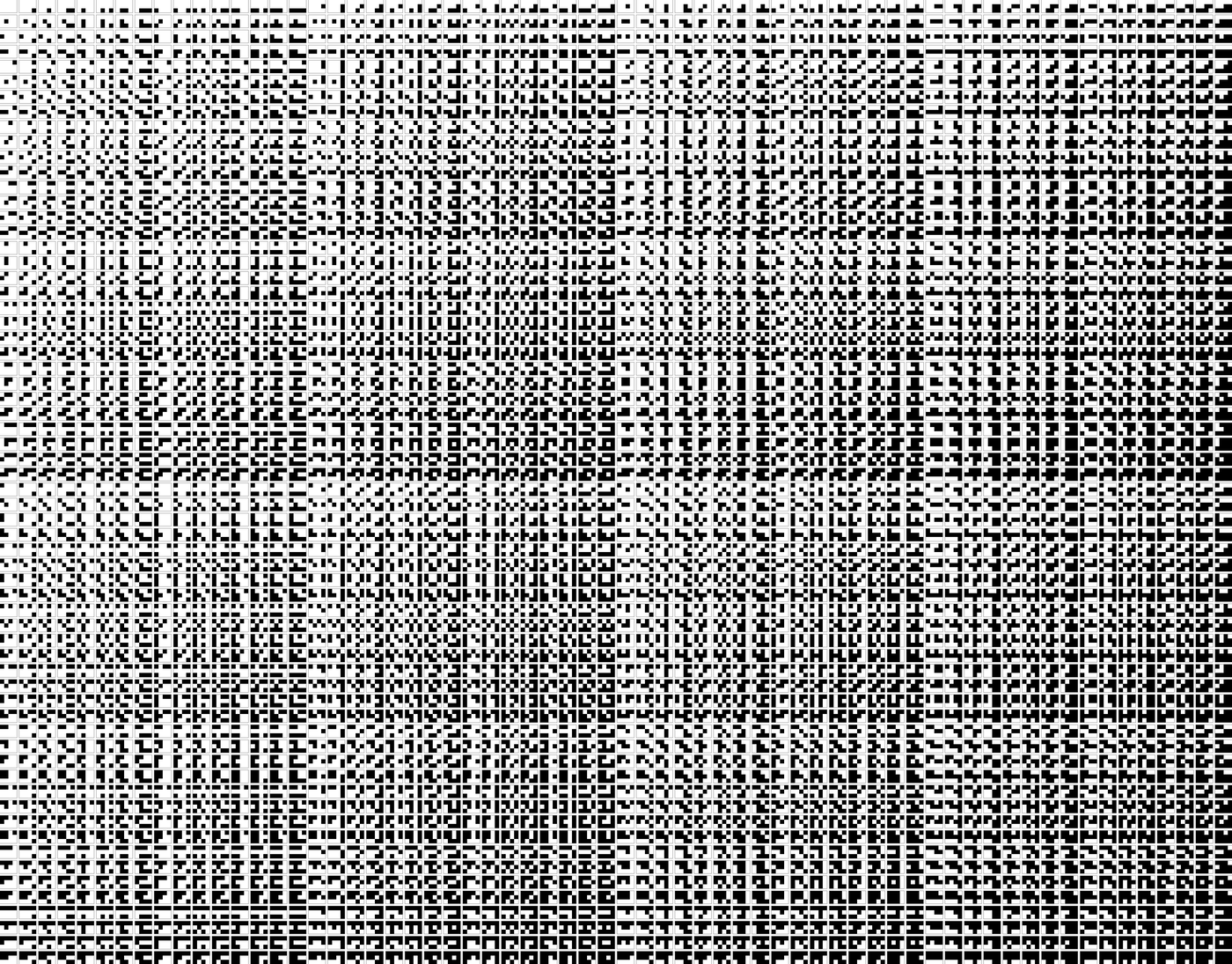
Alle 4.096 möglichen Bilder, in binärer Zählfolge.
All 4,096 possible frames, in binary counting order.